

Iron & Steel Sand Casting Foundry – Liaoning Puyue Machinery Manufacturing Co., Ltd.
Sand casting employs green sand (moist sand) or dry sand to form the molding systems. Green sand casting is the oldest casting process in history, while dry sand casting can be further divided into lost foam casting and vacuum casting. When making the mold, patterns made of wood or metal must be produced to form the hollow cavity. Molten metal is then poured into the cavity and, after cooling and solidification, the castings are formed.
Several sand casting processes exist based on different mold materials. At the sand casting foundry of Liaoning Puyue Machinery Manufacturing Co., Ltd., we are capable of green sand casting, pre-coated resin sand casting (shell molding), and furan resin sand casting. Pre-coated resin sand casting, also known as shell molding, delivers significantly better surface finish on finished castings compared to green sand casting.
Ductile (Nodular) Cast Iron: EN-GJS-400-18, EN-GJS-400-15, EN-GJS-450-10, EN-GJS-500-7, EN-GJS-600-3, EN-GJS-700-2, EN-GJS-800-2 or their equivalent grades
Cast Aluminium and Alloys
Cast Steel or other materials and standards on request
We maintain a full range of in-house inspection capabilities, including:
2. Sand Casting Molding. Resin sand is mixed by sand treatment equipment and then shot into flasks. Molding workers ensure the sand fills all positions and is rammed as solidly as possible.
3. Self-Hardening of Resin Sand Mold. After manual molding, the sand remains loose. The sand mold is then coated with an alcohol-based coating. After ignition, the resin sand mold becomes extremely solid—which is why this process is also called hard mold casting or self-hardening sand molding.
4. Melting and Pouring. Medium-frequency electric furnaces are used to melt iron for the resin sand casting process, just as in conventional sand casting.
5. Sand Blasting, Cleaning, and Grinding. Shot blasting removes sand and oxides from the casting surface. Workers then cut off the gating systems and grind the gating positions and parting lines. The rough castings are thereby completed. If secondary processes such as machining or surface treatment are required, the finished castings are transferred to the next workshops.
Several sand casting processes exist based on different mold materials. At the sand casting foundry of Liaoning Puyue Machinery Manufacturing Co., Ltd., we are capable of green sand casting, pre-coated resin sand casting (shell molding), and furan resin sand casting. Pre-coated resin sand casting, also known as shell molding, delivers significantly better surface finish on finished castings compared to green sand casting.
Capacities and Molten Metal for Sand Castings
In our high-tech facilities, we offer both automatic sand molding machines and manual molding operations in our resin sand casting processes. As an iron and steel foundry, Liaoning Puyue Machinery Manufacturing Co., Ltd. can pour iron castings using our no-bake casting process up to 1 ton finished weight in gray iron and ductile iron, and up to 0.5 tons in steel and stainless steel. We produce casting parts in a wide variety of materials, including grey iron, ductile iron, stainless steel, carbon steel, and alloy steel, based on different standards from China and overseas. Liaoning Puyue Machinery Manufacturing Co., Ltd. is dedicated to the quality of our work, and our commitment to excellence ensures the highest customer satisfaction. As a trusted global partner for high-precision, high-complexity, and mission-critical cast and machined metal parts, we strive to meet and exceed the needs of our customers.▶ Materials for Sand Casting
Grey Cast Iron: EN-GJL-100, EN-GJL-150, EN-GJL-200, EN-GJL-250, EN-GJL-300, EN-GJL-350 or their equivalent gradesDuctile (Nodular) Cast Iron: EN-GJS-400-18, EN-GJS-400-15, EN-GJS-450-10, EN-GJS-500-7, EN-GJS-600-3, EN-GJS-700-2, EN-GJS-800-2 or their equivalent grades
Cast Aluminium and Alloys
Cast Steel or other materials and standards on request
▶ Capabilities of Sand Casting (Manual Molding)
- Max Size of Casting Molds: 1,500 mm × 1,000 mm × 500 mm
- Weight Range: 0.5 kg – 500 kg
- Annual Capacity: 5,000 – 6,000 tons
- Casting Tolerances: On request or according to ISO 8062
▶ Capabilities of Sand Casting (Automatic Molding Machines)
- Max Size of Casting Molds: 1,000 mm × 800 mm × 500 mm
- Weight Range: 0.5 kg – 500 kg
- Annual Capacity: 8,000 – 10,000 tons
- Casting Tolerances: On request or according to ISO 8062
Sand Casting Inspection Capabilities
Our spectrometer checks 15 chemical elements, and our metallurgical microscope produces high-resolution images at 1,000× magnification. Our cleanliness meter determines particle size and quantity to ensure materials meet or exceed international standards. Liaoning Puyue Machinery Manufacturing Co., Ltd. uses ultrasonic detectors to discover flaws, and is equipped with X-ray machines and accelerators capable of scanning castings with a maximum wall thickness of 200 mm.We maintain a full range of in-house inspection capabilities, including:
- Spectrographic and manual quantitative analysis
- Metallographic analysis
- Brinell, Rockwell, and Vickers hardness inspection
- Mechanical property analysis
- Low and normal temperature impact testing
- Cleanliness inspection
- UT, MT, and RT inspection
Steps of the Sand Casting Process
1. Making Patterns. Patterns made of wood, resin (plastic), or aluminum are used in sand casting. Generally, aluminum patterns incur the highest cost, but they are the most suitable choice when customers require thousands of sand castings with higher dimensional tolerances and better surface quality.2. Sand Casting Molding. Resin sand is mixed by sand treatment equipment and then shot into flasks. Molding workers ensure the sand fills all positions and is rammed as solidly as possible.
3. Self-Hardening of Resin Sand Mold. After manual molding, the sand remains loose. The sand mold is then coated with an alcohol-based coating. After ignition, the resin sand mold becomes extremely solid—which is why this process is also called hard mold casting or self-hardening sand molding.
4. Melting and Pouring. Medium-frequency electric furnaces are used to melt iron for the resin sand casting process, just as in conventional sand casting.
5. Sand Blasting, Cleaning, and Grinding. Shot blasting removes sand and oxides from the casting surface. Workers then cut off the gating systems and grind the gating positions and parting lines. The rough castings are thereby completed. If secondary processes such as machining or surface treatment are required, the finished castings are transferred to the next workshops.
Sand Casting Foundry Gallery
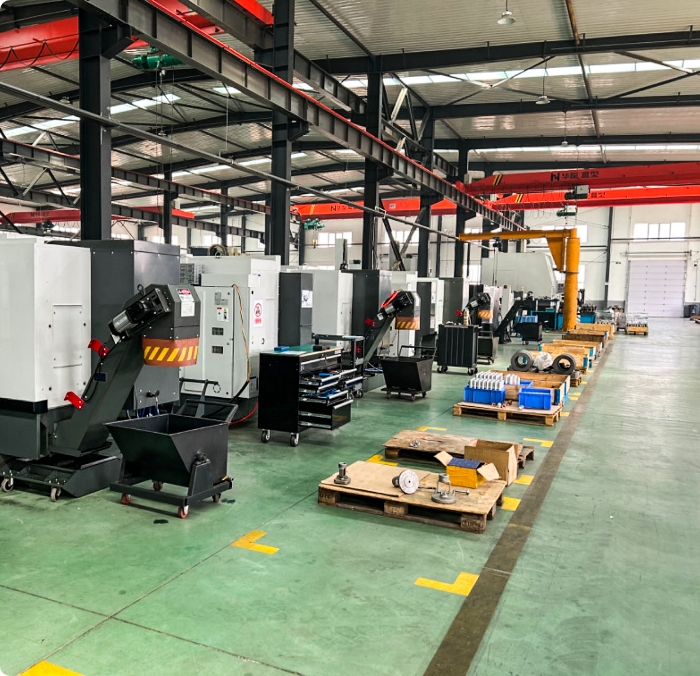
At the foundry of Liaoning Puyue Machinery Manufacturing Co., Ltd., we utilize professional equipment to assemble automatic sand casting production lines. We operate two sand casting lines: a vertical automatic sand casting line and a horizontal automatic sand casting line. These highly organized systems enable us to produce high-quality, high-volume sand castings in diverse materials—including grey iron, ductile iron, carbon steel, alloy steel, stainless steel, aluminum, and brass.
Last One:
China Industrial Museum Visit
Next Article:
Back to list
Get A Quote
Related News Recommendations
Send Your Enquiry
Send Us Your Request And We Will Get Back To You As Soon As Possible.

Shenyang Puyue Industrial Co., Ltd. Was
Founded In 2007, Is A Collection Of Scientific